Showing posts with label dog training. Show all posts

Tuesday, March 28, 2017

Pup-Peroni dog treats? Are they tricking you?

I admit it, sometimes I treat my dogs with bona fide "junk food."  I know it's healthier for them to eat nonprocessed meats, but shelf-stable, soft dog treats are convenient when I can't prepare my own treats.

One type of treats my dogs really like are called Pup-Peroni sticks.  I love that they are easy to carry in a pocket, and easily break into small pieces without getting crumbly.  I was so excited when I saw the big 25 oz. bags were on sale at the grocery store!

But I noticed something funny when I brought home a "big bag."  These Pup-Peroni treats were a lot meatier and larger than the leftovers I still had in my training bag.  Surely they don't shrink when exposed to air???  I bought a brand new, smaller 5.6 ounce bag of Pupperoni and I compared the sticks inside.
A single stick from the
"small bag" weighs 9 grams.

A single stick from the
"big bag" weighs 19 grams.

The difference in length and thickness
between a "small bag" treat and a
"big bag" treat.
I was disappointed that Pup-Peroni uses longer and thicker sticks in its "big bag." The average owner probably feeds their dog a stick or two as a treat, and never considers the stick size might change depending on the size of the bag they purchased.  

I anticipated that the 25-ounce bag would have roughly 5 times as many sticks as the 5-ounce bag.  Surprise!  Not five times, four times, or even three times more. The smaller bag contains about 17 sticks, while the big bag has only slightly more than twice that (37 sticks).  

Is this a big deal?  In the grand scheme of things, no.  Pup-Peroni didn't cheat me by filling a 25-ounce bag with only 12 ounces of dog treats.  But unless I parcel them out carefully, that 25-ounce bag won't last nearly as long as expected. Ironically, I think I prefer the fatter Pup-Peroni sticks because they don't dry out as fast and stay fresher a bit longer when they are in my dog walking bag.

I'm curious if anyone else has ever noticed something similar with dog treats? Let me know if your dog has a favorite treat that works good for training!

Wednesday, January 18, 2017

The Cookie Trap

If you have spent much time around dogs, you’ve probably seen a dog that responds only when the owner holds a treat in their hand. It usually happens when someone has taken an obedience class or two, but doesn’t continue practicing at home. The dog is eager and willing to work for the owner—if treats are visible. Otherwise? Phhht… the dog has more interesting things to do! 
Dogs prefer to work
for something of value

As a result, some people throw the baby out with the bath and refuse to use any treats at all in training. However, just like people, dogs prefer to work for something of value.  How many people would return to a job, day after day, without ever receiving payment? Our currency is money, but dogs intrinsically understand the value of food, which can be dispensed in small amounts and immediately after the desired “work” is done. If you have a dog, you feed him anyway; why not make him work for it? Rewards can be special treats mixed in with regular dog food. 

Keep reading to learn a trainer’s secrets to have an obedient dog without always having a cookie in hand.

Start with the Basics

Often, the first step in teaching a dog a new skill is to lure him: for example, by placing a cookie over his nose, and gradually pushing it back towards his ears, you can encourage him to ‘sit’ and reward him with the cookie.  The next step is to repeat this action so the dog anticipates the behavior. 

Fading the Lure

Once the dog is anticipating the behavior (usually within 5-10 repetitions), only pretend like you have a cookie in hand and quickly lure him into the sit.  If he sits, congratulations!  Immediately reward him with a cookie from the other hand or a nearby treat bag.  He will learn he doesn’t need to see the treat in order to be rewarded.   He should be just as willing to perform for an imaginary cookie, because he knows he will still get rewarded.

* If he doesn’t sit and just looks confused, lure him again for a few repetitions before trying again with an imaginary cookie.  

* If he loses interest, it’s best to put the cookies away and try again when he is hungrier.  Do not bribe him with a cookie at this point!  This is one of the situations where dogs learn to control their owners: “Hmmm, if I don’t sit, she will get out a treat!”  If you are having difficulty at this step, I encourage you to find a dog trainer who can help you recognize a dog that is truly confused vs. a dog that is not interested or trying to get his own way.  


Fading rewards

When the dog is consistently performing the cue using an imaginary cookie, it is time to start fading out the rewards.  One way is by having the dog perform several actions in a row for a single treat.  You can perhaps have the dog do a ‘sit’ for a cookie, then a ‘down’ with a cookie, then another ‘sit’ and a ‘down’ before offering a cookie.  Notice you don’t take away the treats all at once.  Your dog should understand he will still be getting treats, but you decide how often they appear.  

It is equally important when fading rewards that you aren’t consistent in delivery: if you decide to reward after every other command, and then every third command, the dog will quickly figure out the tactic and will lack motivation to work.  But if you reward the dog randomly, say, on the 2nd, 3rd, 5th, 8th, 9th, and 10th tries, he will work harder because he doesn’t know if this will be the one that earns his cookie.

The jackpot is another method to fade rewards, especially useful when performing multiple commands.  A jackpot is a series of small treats delivered one after the other, just like a jackpot of coins coming out of a winning slot machine.  It is more meaningful to a dog to have several small treats offered one at a time, than to have one large treat or multiple small treats delivered at one time.    So if you have your dog sit, then down, then sit again, you can reward him with verbal praise and petting while also delivering a jackpot of cookies, one at a time.

Hoss was a dog that would happily work
just for love and attention.
Once your dog understands the commands, your dog’s favorite activities can be substituted in place of cookies. I encourage owners to switch around rewards with their dogs.  What are your dog’s favorite activities?  Does he like being petted on his neck, having his tummy rubbed, chasing a tennis ball or tugging with a tug toy?  When your dog approaches for petting, have him ‘sit’ or ‘down’ before rewarding him with scratches.  When it is dinnertime, have him ‘sit-stay’ until you are ready to put his dish on the floor and let him eat.  There’s no need to offer a cookie: his reward is his supper.  When he wants to go for a walk, have him sit and stay while you put on his leash, then have him sit at the door threshold before giving him an enthusiastic “Free!” to let him go through the door.  He certainly doesn’t need a cookie for going on a walk with you. The walk itself is the reward.

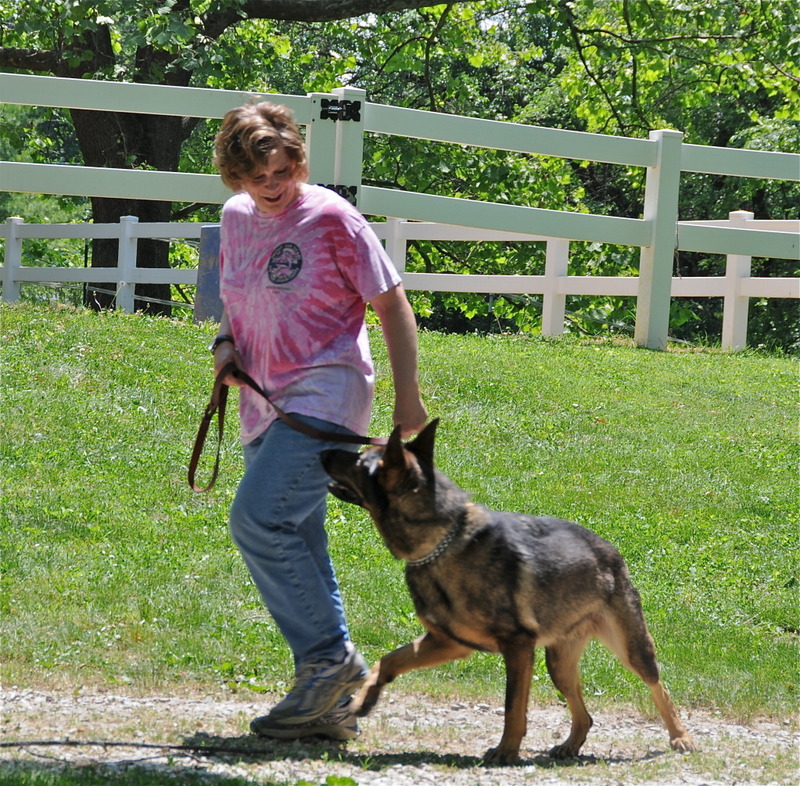
My own dogs are watching intently to see
if they will get a treat this time!
The final method of fading rewards is a process that involves pairing praise with cookies.  It is crucial that the praise starts before you offer the cookies.  The dog’s mind will start to link cookies with praise, and over time, the dog will recognize praise as a reward by itself.   This is the nirvana that everyone seeks: the dog that worships you, does what you ask gladly, and seeks only for your approval.  Most people don’t realize that it can take years to cultivate this, and is a result of careful training where the owner consistently praises the dog before providing cookies.  Note that this process can take a long time to develop, and the mental link will disintegrate if praise is never again followed by a reward.  As a result, good trainers continue to occasionally use cookies, always paired with praise, to help strengthen that mental link.

As you can see, training with cookies does not mean you will need to rely on them for every command for the rest of the dog’s life.  Once your dog understands the basics of a behavior, you should stop using the cookie as a lure.  It is helpful to continue to reward the dog randomly throughout his life, but rewards can vary from praise, jackpots, and real-life rewards.
-->

Wednesday, January 11, 2017

The Command That Could Save Your Dog's Life


Use the same phrase every time
you call your dog. 
As a dog trainer, I like to start by teaching my clients' dogs the most important and potentially life-saving command, “Come.” Sit, Down, and Stay are terrific, useful commands, but the recall ranks at the top for importance. I start by explaining the three essential aspects of training, which are true regardless of the command you are teaching. They are the keys to dog training success.

Word choice

First, you need to have consistency. In a dog's mind, "Fido, come!" is not the same as "Here, Fido!" What word or phrase do you want to use? Write it down on an index card on the refrigerator so everyone in the family can practice using the same cue.

Treats and Praise

The second key to success in recalls is making it fun for your dog to come to you. For most dogs, this can be easily achieved using tasty treats. You can also make yourself silly, play with your dog, and get excited, happy, and playful when he comes running to you.

Treats are best given in very small morsels like a jackpot machine, one after the other. I typically will give from 3 to 6 morsels for each reward when the dog comes running, while praising excitedly the whole time. Dogs actually enjoy this experience more than a single, large reward.

Note that some dogs want to play chase after coming to their owners. They will come almost in arm's reach, and then dart off for more "chase-me!" fun. This is incredibly dangerous behavior if your dog gets loose. I once saw a Boxer on the run; he came to the owner, danced away excitedly and ran right into oncoming traffic. To prevent this tragedy, offer a tasty treat in one hand, but only give it to the dog when you have successfully taken hold of his collar with the other hand. Once the dog has the treat, you can let go of the collar and let him play again. If you have a "chase-me" dog, you will want to practice the collar-grab/treat routine until the dog is totally comfortable with it, and regularly thereafter. It is also helpful to ask the dog to 'sit' before providing the treat, and then reward him with the treat(s) and a burst of raucous play.


Practice

Repetition is the third key to success. Practice while walking your dog on leash, letting him get ahead of you, then suddenly backing up and calling him to you. Try calling him from the front door of your house, using a long leash to make sure he can’t run for the hills. If needed, you can reel him in after calling him. Practice anywhere your dog could potentially get loose or wherever you need to call him, for example, from the back door. Put the long leash on him so you can guarantee that he will return, but make it worth his while with tasty treats and praise.


Common Mistakes

There are also three important, common pitfalls to avoid while teaching your dog the recall. These fundamental mistakes sometimes defy common sense, but I will explain why it is absolutely crucial that you avoid the following:

Never punish your dog for coming to you. To a dog, he associates what happened in the past 2-3 seconds with your actions. For instance, imagine if your dog digs through the trash and goes romping around the neighborhood, and you are desperately calling him and he isn't coming to you. Your naughty pup has made you scared and angry, and your instinct is to punish him when he finally comes to you. If you do, the dog will associate your anger and punishment with the act of him coming to you. If he runs off again, he will be afraid to return for fear of punishment. In this situation I tell my clients they are allowed to swear at the dog, as long as they do it in a very sweet voice that sounds like praise. Sometimes it can be difficult and embarrassing to praise and reward a dog when all your neighbors know you've been chasing him around the neighborhood for a half-hour. It is still far better to praise your "naughty" dog, than to end up with a dog that refuses to come back at all.

The second rule: Except in life-threatening emergencies, don't call your dog if you know he won't come. If your dog is having a fantastic time at the dog park, and you call hi to come without prior training in that environment, you are setting him up to fail. In this case, you can encourage your dog but avoid using your trained recall command. If your recall command is, "Eddie, come!" it would be better to say something like, "OK Eddie, time to go!" Only use your trained command either when you know your dog will come, or you can get him to comply by reeling him in from a long line. Even if you have to reel him in, you should reward him for coming so next time will be easier.

The third rule: never chase a dog you want to catch. Tempting as it is, dogs will always be faster than humans, and their fight-or-flight response will kick in while you are chasing. The best way to catch a loose dog is to let him chase you: call him and start running backwards or perpendicular to him. An alternative is to drop to the ground and make puppy noises or pretend like you are eating something. You might or might not get the dog curious enough to explore, but I can tell you from experience that you don't stand a chance chasing a healthy, young dog.

Just like with all health-related advice, an ounce of prevention is worth a pound of cure. So, teach your dog to come and accept having his collar grabbed, make it fun, and practice it regularly!


Wednesday, April 23, 2014

Treats, treats, treats!

Dog with "Will Work for Food" sign

Beginner students always want to know, “What are the best kinds of treats for training?”  Ideally, treats should be
1.)    Small—roughly pea-sized or smaller
2.)    Smelly—holding a smelly treat in front of a dog’s nose is most effective at getting the dog’s attention
3.)    Soft—hard treats require chewing and generally are not as enticing or smelly
4.)    Variable—dogs get bored with a single type of treat, so mix it up!  Your dog never knows, in advance, which kind of treat he’s getting.  Training night is like Halloween trick-or-treating for dogs!

For the first night of a beginner class, you will need a lot of treats.  However many treats you think you need, multiply by four.  It’s OK to have too many, but training is very difficult in the learning phases when you run out of treats.

Recommended treats:  far and away, my favorite choice for a treat is Natural Balance Lamb or Turkey
Natural Balance Dog Food Rolls
dog food rolls.  Sliced into ½” thick slices, they are easy to break into pea-sized treats, nutritionally balanced as dog food, and most dogs love them!   The downside is that they need to be refrigerated after opening, and they will turn to crumbs if they are smashed in a treat bag.  Petco sells these rolls. 

Petsmart sells something similar, and also good, the Pet Botanics Dog Food Rolls.  You will need to experiment to see which ones hold up best (some are more moist, while some are more crumbly).
Pet Botanics Dog Food Rolls
Other great options are diced pieces of chicken, turkey, ham, braunschweger, cooked liver or steak, small pieces of hot dog, or string cheese.  Check out the deli section of your local grocery store.   You definitely want to test these with your dog before bringing a huge amount to a training class.  For my dog, too many hot dogs will cause diarrhea, but he adores, and is fine with the messier turkey-cheese dogs!   Too much cheese can also cause digestive problems for some dogs. 

A final healthy option for dogs is dehydrated liver or dehydrated meat.  Most dogs go bonkers for the dehydrated treats, but they are expensive and very difficult to break into smaller pieces, so I use them sparingly.

Occasional treats:   variety is the spice of life, so I mix in some “occasional” treats while training.  Some dogs like crunchies: mini-Milkbones, Charlee Bear treats, or even Cheerios.  Try them first to make sure
Charlee Bear dog treats
your dog likes them—my dog likes the egg and cheese Charlee Bears, but not the liver variety.  In the “junk food” category of dog treats, are marketed soft dog treats like Bil-Jac Liver treats, Pupperoni sticks, Canine Carryouts, Milo’s Kitchen, and Beggin’ Strips.  These are not the healthiest choices for your dog, but may be okay in small amounts.

Things to AVOID:  Avoid any treats made in China, especially chicken or duck jerky.   The FDA is currently researching Chinese jerky treats to determine why so many dogs are getting sick from them, but for now, simply avoid them and make sure if you buy something with chicken, it is made in the U.S. or Canada. For info about the FDA and chicken jerky, click here: http://www.fda.gov/forconsumers/consumerupdates/ucm092802.htm

Important reminder:  Your dogs will get fatter than a turkey at Thanksgiving if you start training them regularly and do not reduce their regular food intake.  If you are training at home, it is perfectly okay to use part or all of their regular meal to work with them.  Dogs are generally happy to work for their ordinary food, if they like their food. However, ordinary food will not entice them when they have extraordinary distractions such as other dogs and new smells in a training class.  Bring the good stuff to training and reduce their food for the day.  Your dog will thank you!


Tuesday, April 8, 2014

Finding a Good Dog Trainer


Currently, there is no licensing or credentialing system required in Illinois to be a dog trainer. Anyone can claim to be a trainer.  How can you find a good trainer?  Here are some questions to ask:

  • Does the trainer have experience working with your breed of dog?  Each dog breed has different characteristics, and a good trainer will have experience with multiple dog breeds and hopefully with your specific breed.  A trainer who only works with German Shepherd Dogs, for instance, may not fully understand the timid nature of an Italian Greyhound or the tenacious focus of a Jack Russell Terrier.  
  • Does the trainer keep up with the latest scientific methods of learning and behavior?  A good indication of this would be if the trainer is a member of the Association of Professional Dog Trainers. If the trainer is doing the same thing they've been doing for years, it indicates they might not care about finding the best methods of dog training. Older, outdated methods of training can be effective, but often are unnecessarily harsh.
    Group training classes cannot fully address
    difficult-to-manage behaviors at home.
  • Will the trainer work with you to practice in your home, neighborhood, or areas of difficulty?  While learning in classes can help create good behavior, problem behavior is best addressed at the source. Correcting problem behavior almost always requires some creativity and a willingness for the trainer to observe and make recommendations based on the dog's environment during the behavior. 
  • What training tools will the trainer use with your dog?  ​A trainer's motto should mimic a doctor's creed, "First, do no harm."  Find out specifically what the trainer will do to correct problem behaviors. Does the trainer plan to use a prong or pinch collar; an electronic collar; a harness; head halter; clicker and treats; or toys? If you are not comfortable with it, do not let him or her do it.  You are responsible for your dog's well-being.  Your dog depends on you to protect him in the human world.  You have the right to refuse any part of the training regimen that you think will be detrimental to your dog, no matter how learned or experienced the trainer is.  You know your dog best.  
  • Finally, observe the trainer in action.  If a trainer isn't willing to let you see what he or she is doing, you probably don't want him or her touching your dog!

Sunday, January 6, 2008

Entering the world of Tracking.... or not...

Today was a big day for me.

One of my goals for the new year was to teach my puppy how to track. I would love for her to be able to follow the scent to find a glove my son dropped. I got online and found a group of tracking people, one of whom informed me there was a tracking test this weekend at a location less than an hour's drive from me. Yippee! I could see dogs tracking and hopefully meet some people to help me in this journey.

Last night I had dreams about tracking, meeting wonderful people, sitting around a table discussing our dogs and dog sports.

This morning I got up early, ready to see a tracking test in action. It started at 9 so I planned to leave at 8. I decided to bring my Giant Schnauzer Atlas along for moral support. (Besides, what kind of an idiot goes to a tracking test without a dog?) Then I realized if I took Atlas, I'd have to take the puppy Phoebe. At the last minute, my 5-yr. old son Gabe also wanted to go, so we all jumped in the car and off we went.

Since Gabe had decided to come at the last minute, he hadn't had breakfast yet. My job was to find him something to eat without delaying us too much. I was looking for Wendy's, but the one we passed was closed. I realized it was pretty hopeless as we arrived at what I assumed was our destination, the empty fields of Wisconsin. There weren't going to be any Wendy's around here. Is there anything worse than a hungry 5-yr. old?

There was a very dense fog and I couldn't find the road to turn onto. According to mapquest, it should have been 3.5 miles after I turned onto highway B. There were several roads to turn onto, each with a name different than the one I was looking for, but I tried them anyway. Mapquest has never been wrong like this before! I drove all the way back to where I turned onto Highway B, reset my trip odometer and measured out exactly 3.5 miles-- there was no road to turn onto which I hadn't already checked. It was already 10 minutes after the tracking test was supposed to have started.

I realized I didn't need a tracking dog so much as I needed GPS.

I did what any normal adult would do in this situation-- I called my mommy. "Mom, does GPS work in heavy fog?" "Yes, I think so... why? Isn't your GPS working?" "No Mom, I don't have GPS and I'm gonna kill my husband if he doesn't get it for me..." I ended up talking to my stepdad who tried to navigate me long-distance with a teeny-tiny map. There weren't any locals to ask. No churches or people anywhere. My stepdad Bruce told me to keep heading east, which I was doing, and hallelujah! There was a town, with real people in it.

I stopped at the gas station to fill my famished youngster and ask for directions. After buying a can of Pringles and a sleeve of Donettes for Gabe, I asked the young cashier where this mystery road was. "Uh, I think it's back that way..." she said, not too helpfully. "Oh wait, that guy over there's been here his whole life, he'll know how to get there..."

Sure enough, the tall man knew exactly where the road was and gave excruciatingly detailed directions to get there. I guess he wanted to make sure I didn't get lost again. "Go into town. Turn left at the stoplight. Not the first stoplight, but the second one, that's really in the middle of the town. You're going to take Rte. 67 past the old Pick-and-Save and then turn right. You're going to go past Highway K, Peters Road, and then you'll come to the road. You can't miss it, it's at the top of a hill and there's a little creek going through just before it." I can't remember even 1/4 of what he told me, but I figured I had the important points and I'd best be heading on. It was now 20 minutes after nine, and I wondered how much I had missed.

A very kind woman followed me out to the car. "Are you sure you can make it?" she asked. "I live down that way, and you can follow me if you need help." "Oh thank you, I'm sure I can find it!" I said enthusiastically. I realized that the puppy had been riding in the car for over an hour and I had better offer both dogs a potty break.

As I opened the rear hatch of the minivan, I grabbed at Phoebe's collar and told Atlas to "Wait." Atlas is very good about waiting in the car until I get a leash on him. Normally. This time he jumped out and trotted right over to a man walking by and sniffed him. One thing I have to say for Cheez-heads: it takes more than a big black dog to scare them! I got Phoebe's leash on and grabbed Atlas.

After both dogs had relieved themselves, I returned to the back of my minivan. Phoebe has a tendency to get carsick and today was no exception-- a big pile of pre-digested dog kibble awaited. Oh well, there'd be time to clean it up later.

The fog was as thick as marshmallow fluff and I wondered if I'd ever find this place. I was exactly one hour late by the time I finally arrived, but I was ecstatic just to have found it. I grabbed Atlas and Gabe, leaving the puppy behind in the van, and went looking for the trackers. We walked to the back of the house, peering into the fields around. I couldn't see or hear anyone. Hmm...

We came around to the front of the house, and a woman appeared from the front door and told me that the tracking had been suspended due to the fog. Everyone was waiting in the house. "With their dogs?" I asked curiously. "No, the dogs are all in the cars." So I left Atlas in the car and headed with Gabe into the house.

There's nothing like walking into a group of, say, 20 people I've never met before, who are doing something I know nothing about. Trying not to make a fool of myself. Praying that someone would say something--anything to me. I suppose nearly everyone in the group was equally shy, because nobody said a word to me. If only I could figure out whose house it was, and find the guy who invited me to come!

It seemed like forever (probably a couple of minutes) before a woman looked at me with my little boy in tow and asked if I was here to track. I explained my story and slowly people warmed up. Mostly I sat and listened to others as Gabe crawled around me as only a 5-yr. old can do. Finally, they announced that we were ready to start the first track, and anyone who wanted to watch-- if that was possible with the thick fog--should follow along.

We had to drive to get to the first track. A row of cars took off following the leader. At one point I couldn't see the car's tail lights in front of me, but then they reappeared at a stop sign. The lady jumped out of her car and motioned to me. "Which way did they go?" she asked. I had no idea, I could barely even see her car in all this fog! She turned left, and I decided to turn around and go home. If I couldn't see the car in front of me, I wasn't going to see much of any dogs tracking. It was already 11 AM as I headed for home.

Tracking is sure a lot harder than I thought.