What Methods Should I Use to Train My Dog?
Recently I was asked by a client the best way to start training a new dog. He had trained a dog years ago using leash corrections, but his wife wanted him to use positive reinforcement training. He was hesitant to use treats with his dog, as he didn't want his dog getting spoiled and fat, but his wife didn't want him using a choke collar or strong leash corrections. He asked what I would recommend.
I could certainly relate to this dilemma! When I started training my 95-lb. Giant schnauzer, Atlas, I was taught to use treats occasionally to reward good behavior. When correcting bad behavior, I was taught to tug on the collar or grunt a guttural-sounding "uh-uh." In terms of behavioral psychology, the treats are considered a reinforcement because they increase the likelihood that a behavior will occur in the future. Likewise, the collar correction and "No" are considered punishment, because they decrease the likelihood of that behavior happening in the future. Punishment can be either a mild correction, like a tug on the collar, or a much harder correction, like a beating or a powerful electric shock. In this article I refer to mild corrections, but since "punishment" has such bad connotations in some people's minds, I will refer to it as "discipline."
(For the sake of simplicity I'm not covering the positive and negative quadrants of reinforcement and punishment.)
 |
| "But he KNOWS how to sit!" |
Let's start with a common example: when Atlas was heeling and didn't sit, I would jerk on the leash or tap him on the butt. He learned to sit most of the time, but I still had to provide corrections every once in a while. Sometimes I rewarded him with a treat if he sat nicely, but the reward didn't seem to help him sit more**. If I didn't correct him the first time he didn't sit, it was guaranteed the next time he wouldn't sit. Initially I thought he was being stubborn, or trying to see what he could get away with, so I escalated with a more firm tap or harder jerk on the leash. This is one of the dangers of punishment: if it is mild and doesn't stop the behavior completely, training escalates with harsher punishments. If it is harsh enough to stop the behavior completely, then it might be considered abuse.
Over time, the more I worked with him and disciplined him, I realized that Atlas really resented my demands and did not want to sit for me. In addition, I wondered if he had a spinal problem that was making it difficult for him to sit. I decided I wasn't going to dole out harsh punishments when I wasn't sure he could safely and comfortably do what I was asking. At this point, obedience training was no longer fun for either of us, and wasn't necessary for any other reason, so I completely quit.
 |
This is my dog Phoebe
pulling her cart! |
Fortunately, I took a clicker-training class and taught him silly stuff, just for fun. I attended a seminar to teach him to pull a cart, and the instructor had us using small, meaty pieces of food as rewards for approaching the cart, then walking next to the cart, then letting the cart bump the dog. Before I knew it I could hook Atlas into the cart and he was happily pulling it around. He loved doing it. You could see his eyes shine with delight when I pulled the cart out. It might have started as a love for the food I was giving him, but I learned a valuable lesson: the enthusiasm your dog shows when trained with food, if you do it properly, will transfer to enthusiasm towards the behaviors you are training.
Scientific studies of dog training show that dogs learn better using positive reinforcement methods, and food is one of the most basic, primal reinforcers that almost every dog values. Everyone knows how persistent dogs are when they want something. If you train properly with food (as a reward and not a bribe) the dog learns that he won't always get a treat for good behavior, but he will keep trying because sometimes he gets a treat. That is the benefit of positive reinforcement training: the dog will continue to try.
It goes deeper than that, though. If the dog is trained with discipline, he will come to respect discipline. Like a Marine who makes his bed every day in the barracks, he will do what he must to avoid dressing-down by the Sergeant. In this case, the behavior is leaving a messy bed, the punishment is getting yelled at, and the desired consequence is the Marine no longer leaves a messy bed. One of the drawbacks of punishment is the authority must be able to enforce demands. Once the Marine is out of the barracks, is he going to leave a messy bed again? The answer depends on whether the Marine thinks making the bed is worthwhile. Discipline is only effective as long as someone stronger is there to enforce it.
 |
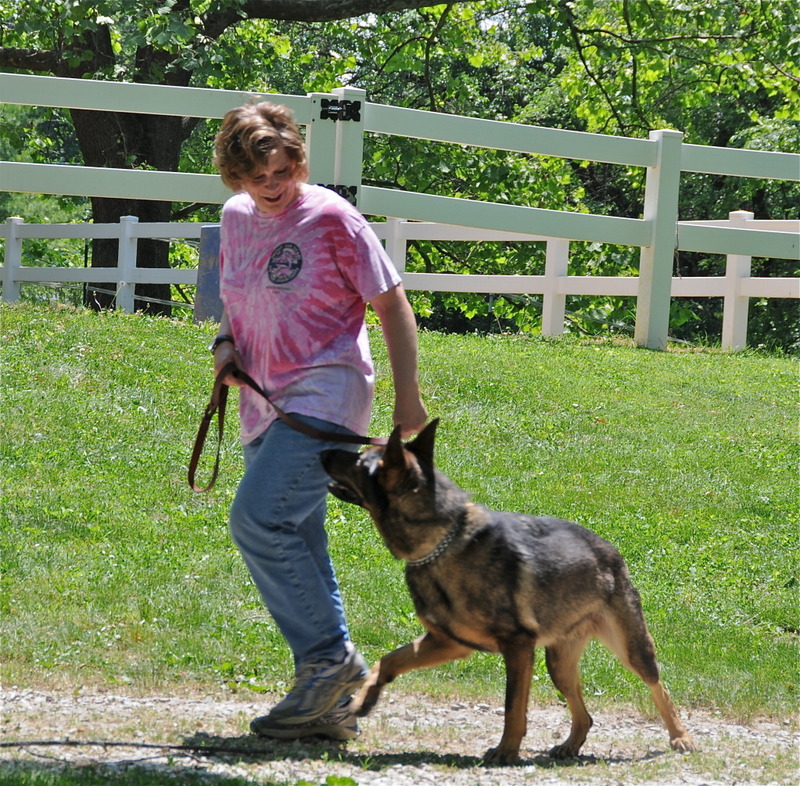
| Hoss is demonstrating a focused "Heel" exercise. |
For dogs, almost any behavior can be taught, and it doesn't require a drill sergeant. With positive reinforcement, there is more teaching right from the start. For example, in loose-leash walking, the dog has to be taught the right way to do things, exactly what you want him to do. Instead of "don't pull", you have to teach him, "I want you to stay where you can see me at all times, by my left side, on walks." He learns he is correct because you reward him, and he learns he is wrong when he doesn't get a reward. In the beginning you have to reward very frequently to let the dog know he is doing it right and encourage him to keep working. This is one of the drawbacks of positive reinforcement training: more training is required at the start. Another drawback is that it requires a lot of treats, although you can use some of your dog's food, or cut down on your dog's daily meals, to counterbalance the treats given.
A common assumption about positive reinforcement training is that the dog will only work for treats. It happens fairly often: while initially you lure a dog into position using food, if you don't fade the lure quickly it turns into a bribe. Once the dog learns how to work for bribes, he will only work if a treat is in sight. This develops when an inexperienced trainer doesn't reward appropriately, anticipates giving the reward, or gets a treat ready before the dog has started the behavior. Fortunately the dog can be easily re-trained using better timing: unfortunately, it is harder to re-train the trainer!
 |
Following 170 lbs. of dog before
they learned loose-leash walking--
difficult at best! |
For loose-leash walking, the benefit of positive reinforcement training, even though it requires more work in the beginning, is many years of enjoyment with your dog while occasionally reinforcing with treats. Compare that to discipline training, where you must be physically able to restrain the dog, and periodically discipline him to remind him what you want.
Many trainers use a combination of these two teaching methods, generally using punishment when the dog understands but isn't performing correctly. Most people agree it is unfair or abusive for a trainer to punish a dog that doesn't understand the behavior yet.
The issue then becomes: how do you know your dog understands what you are asking of him? Dogs do not generalize behaviors well: learning to "sit" in the kitchen does not mean he understands "sit" in the living room. Even after he learn how to sit throughout the house, taking him to a new environment, with extra distractions, may result in him not deciphering your command, "Sit". Dogs do learn quickly with repetition, so teaching a dog in a new location is faster, and eventually he can generalize the behavior with almost any distraction. But far too often I hear my students say with frustration, "He knows how to do this!"... when the dog is showing me that he does not understand.
As a trainer and dog advocate, unless I am 100% sure the dog understands the behavior, I will presume the dog is trying his best but just doesn't understand, and teach him again. Honestly, I cannot read dogs' minds, so I always prefer to give him the benefit of the doubt. Sometimes it is obvious the dog is confused, and other times I can see a distraction pulling him away, but I can say with certainty that I have never, ever regretted giving the dog the chance to re-learn instead of punishing him.
Positive Reinforcement: Pros:
- Dog wants to learn, and the enthusiasm transfers to the behavior
- No physical intimidation is necessary
- Any size and strength of human can teach the dog
- Builds a great relationship with the dog
- Encourages the dog to keep trying behaviors
- You have to feed the dog anyway, why not train him at the same time?
Positive Reinforcement: Cons:
- Trainer needs good timing and skill, or else dog will not work without treats
- Managing the dog on leash with a handful of treats is more difficult
- It takes more time to teach the dog, at the beginning
- Dogs not trained to take treats gently can cause bloodshed
- Dogs can get fat if daily meals are not adjusted
- If the dog doesn't value the reinforcer, the behavior will not increase
- Requires planning and preparation to have treats available when needed
- Can be messy, both with treats and dog slobber
Punishment: Pros:
- Can be faster than positive reinforcement
- A single strong punishment can stop a behavior for a very long time
- Does not require any treats
- Does not require planning ahead
Punishment: Cons:
- Less precise in creating behaviors (you are telling the dog what you don't want, but not what you do want)
- A mild correction frequently ends up escalating to stronger punishment
- A strong punishment can be considered abusive
- Dogs can react unpredictably to punishment and might become fearful or aggressive
- Dogs can associate you with the punishment and it undermines a trusting relationship
- Punishment discourages the dog from trying new behaviors
- Punishment is only effective as long as someone stronger is there to enforce it
 |
| Guess which hand the treats are in? |
In the end, it's up to you to create the relationship you want with your dog. I have found the best way to do this is with positive reinforcement, and that is what I encourage my clients to do with their dogs, too. A good trainer will set you on the road to success by teaching you how to use a clicker, how to get your dog on a variable schedule of reinforcements, and how to prevent or re-train undesired behavior.
Have I left out any important pros or cons about each method of training? What has been your experience? Let me know in the comments below!
** As far as rewarding Atlas when he sat, there were numerous reasons why I was not successfully increasing that behavior. Mostly it was due to was my lack of timing and skill as a trainer! Fortunately, both have improved significantly with practice and experience.


 Often, the first step in teaching a
dog a new skill is to lure him: for example, by placing a cookie over his nose,
and gradually pushing it back towards his ears, you can encourage him to ‘sit’
and reward him with the cookie. The next
step is to repeat this action so the dog anticipates the behavior.
Often, the first step in teaching a
dog a new skill is to lure him: for example, by placing a cookie over his nose,
and gradually pushing it back towards his ears, you can encourage him to ‘sit’
and reward him with the cookie. The next
step is to repeat this action so the dog anticipates the behavior.  The jackpot is another method to
fade rewards, especially useful when performing multiple commands. A jackpot is a series of small treats
delivered one after the other, just like a jackpot of coins coming out of a
winning slot machine. It is more
meaningful to a dog to have several small treats offered one at a time, than to
have one large treat or multiple small treats delivered at one time. So if you have your dog sit, then down,
then sit again, you can reward him with verbal praise and petting while also
delivering a jackpot of cookies, one at a time.
The jackpot is another method to
fade rewards, especially useful when performing multiple commands. A jackpot is a series of small treats
delivered one after the other, just like a jackpot of coins coming out of a
winning slot machine. It is more
meaningful to a dog to have several small treats offered one at a time, than to
have one large treat or multiple small treats delivered at one time. So if you have your dog sit, then down,
then sit again, you can reward him with verbal praise and petting while also
delivering a jackpot of cookies, one at a time.